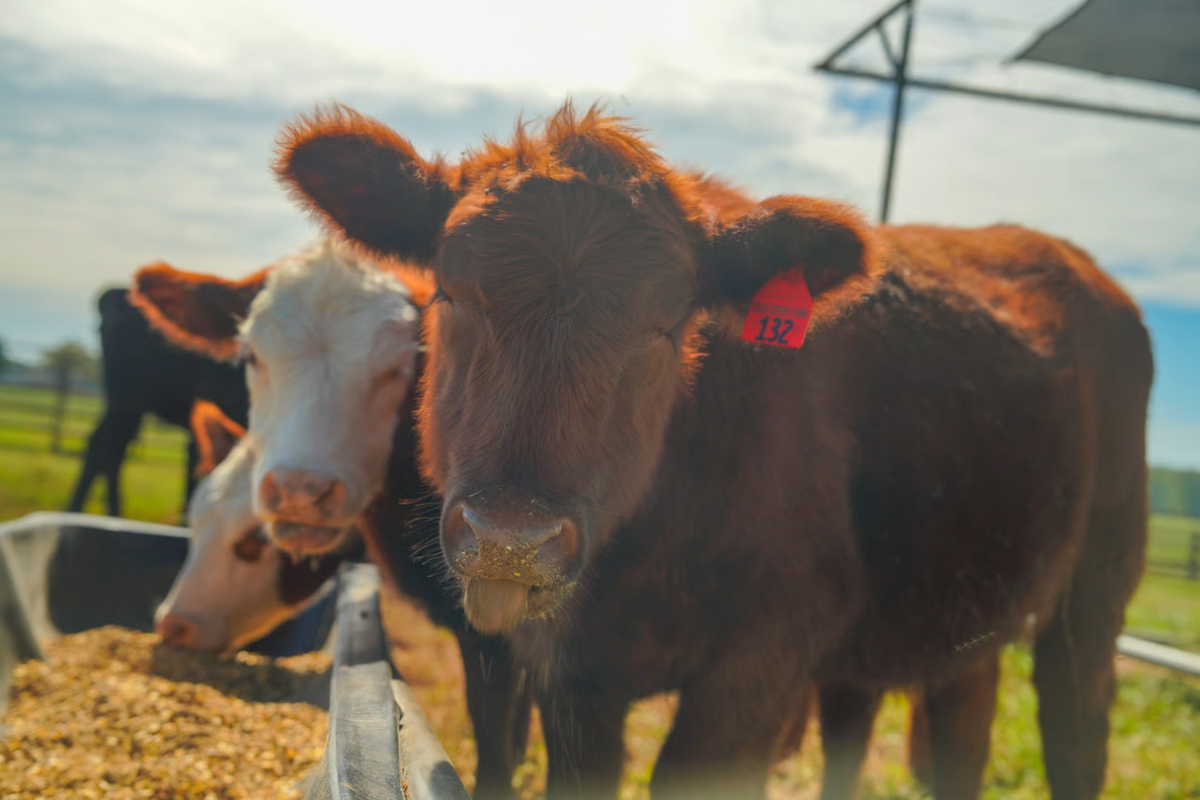

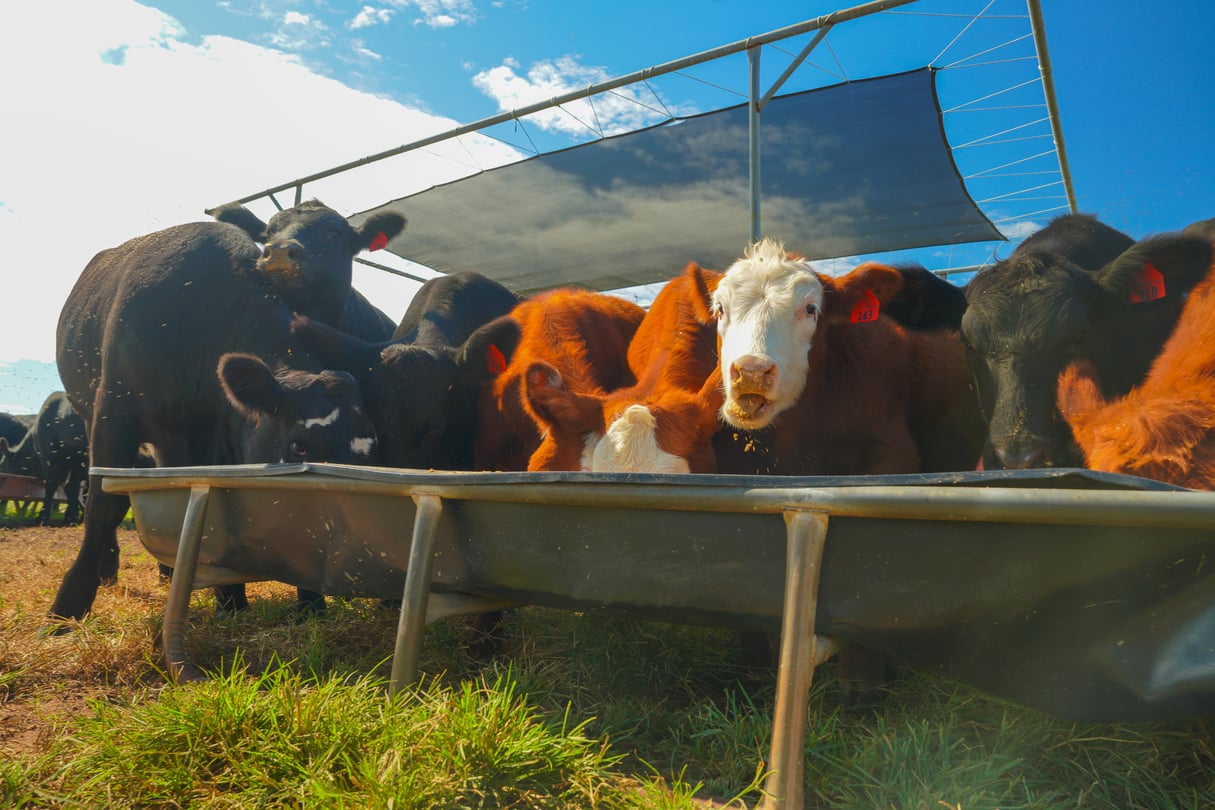
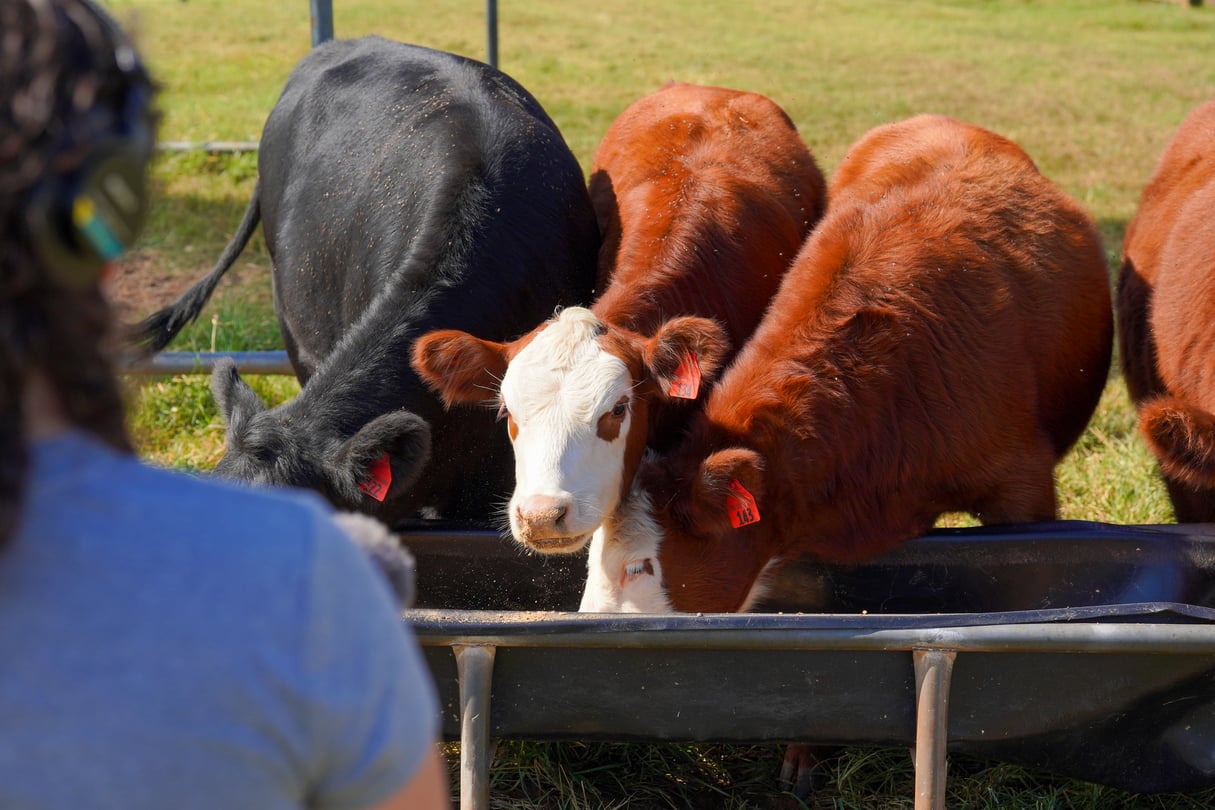
Brad Hines rattles a bucket of feed on a wide, flat pasture outside of Athens. It’s about 100 acres owned by the University of Georgia, where students from its College of Veterinary Medicine learn the ropes taking care of about 40 to 50 cows.
A few curious black and red angus cows sidle up to the trough as Hines explains that working with students in these farm settings is important because there’s a shortage of rural veterinarians to take care of Georgia’s herds and flocks.
“It can be a daunting method of practice, easy to take 80 to 90 hours a week to accomplish this practice,” Hines said. “You’re constantly on call, and so, that may be a lifestyle change that people choose to take on.”
This veterinary medicine program is the only accredited one in Georgia. Hines says the degrees are the animal-analog of getting a doctorate of medicine to care for humans. UGA takes about 150 students each year, although it receives far more applications than they have space for — about 2,000 a year, according to Hines.
But relatively few of those students are looking to work in rural areas. Hines estimates only about 40 per class.
Victoria Nave is one of them.
“I grew up in a rural community around agriculture,” she said. “I was raised on a hobby farm, so I’ve always been around animals and interested in that world.”
She said by the time she was five years old, she knew she wanted to be a vet.
“I want to give back to the community that raised me and got me to where I am,” Nave said. “It’s definitely not glamorous, but I think in a rural community, you really get to know the people that you are serving, and it’s more than just a job.”
There are trade-offs though.
Rural veterinarians have a hands-on, around the clock job that pays less than their urban counterparts, and those who do take these roles can be spread pretty thin.
According to the U.S. Department of Agriculture, there are hundreds of counties in need of a rural veterinarian, and many have gone years without those positions filled.
Veterinary colleges, like at the University of Georgia, nonprofits, and the federal government are all looking at ways to understand where rural vets can fill the gaps and how to support and fund those professionals more adequately.
Challenges to entering the field
Nave said money is the biggest issue for vets going into rural practice.
“We’re taking out a lot of loans, and taking on a lot of debt, in order to get to this point in our lives,” she said. “And when you’re going into rural vet med, you’re not getting the highest salary you could be.”
Rural veterinarians statistically tend to make less money than their urban counterparts, according to the U.S. Department of Agriculture.
Additionally, for those vets who do go to rural areas, getting their businesses established and staying long term is a whole other challenge.
“The first year, year or two can be really tough,” Hines said.
He would know. Hines himself was a rural vet for years before coming to UGA.
He explained that it’s a big transition to work in a rural area — joining a tightly knit community, establishing a practice, and if young graduates are married it can sometimes be difficult for their partners to find work in small towns.
Hines said getting regular work aside from emergencies can be difficult because in some areas farmers aren’t used to having regular vet care nearby. On the flipside however, the hours can be grueling with vets staying on-call around the clock.
Possible solutions to support rural vets
The U.S. Department of Agriculture recently released a study on the rural veterinarian shortage nationwide, one of the first the agency has done to better analyze what is happening with rural vets.
It found more than 200 of designated shortage areas for rural veterinary practices. In Georgia, there are currently 7.
The USDA also found rural practices are struggling financially.
The average rural veterinary practice’s revenue declined from 2021 to 2025. The study attributes that partly due to declining food-animal herd sizes, and there being fewer vets per practice.
In turn, personal income for rural vets taking care of farm animals also decreased during that time period. The USDA also estimates that between 2017 and 2024, income for rural vets working with just “food animals” declined by 19%.
With that in mind, the USDA is encouraging students to become rural vets by offering more money through its Veterinary Medicine Loan Repayment Program.
“The loan repayment conversation is a very important piece,” said Laura Stump, deputy under secretary for research, education and economics with the USDA.
Some of the USDA’s designated shortage areas have been nominated as locations to host vets in the repayment program for many years in a row, Stump said. Although some have very low application rates, and a few never receive any applications.
Last year, the USDA put more money toward the program to help incentivize filling these positions. Now, vets in those specified rural areas can get up to $40,000 a year in loan repayment help, plus assistance on taxes.
Stump said the agency is also working on a larger plan to address the rural vet shortage because it’s a critical issue for the country.
“Veterinarians are very, very important — particularly the food animals in the USDA perspective — for food safety, for abundance, and health of the U.S. food supply,” she said.
Other organizations are looking at ways to support rural vets. Michael Bailey, former president of the American Veterinary Medical Association (AVMA), said the organization works on advocating for policy changes that benefit vets.
One of their issues is strengthening the loan repayment program.
Bailey said that for vets, an issue with the loan repayment program is how it deals with taxes. For the USDA’s vet loan repayment program, the government takes out money — about a third — for taxes before distributing funds to vets.
He said for medical doctors receiving a similar government loan repayment grant, they use all the money to reimburse for student loans and don’t get money taken out for taxes.
AVMA also is looking to address wellness and burnout issues for rural vets.
“We want people to know that they can have a quality of life, so we’re trying to do everything we can, basically, to make sure they know that there is wellbeing health services and that there is associate support,” Bailey said.
He said the organization helps find auxiliary veterinarians, so rural vets can take time away from their practices for vacations and personal time.
Retention and tracking
Meanwhile, Hines said UGA and its partners are still working to get a better handle on the exact scope of the rural vet shortage in Georgia. Even with national data like from the USDA, he said there are still a lot of unknowns. So, the university and the UGA Cooperative Extension service is cold calling graduates and farmers to learn more.
“We’re working on some data right now that’s trying to identify areas of veterinary deserts across the state, and even that number is hard,” Hines said. “A veterinarian may be present in a community, but we don’t know if they’re doing just small animal or if they’re doing equine or food animal or poultry, and so it’s very difficult for us to know, ‘is this area truly underserved?’ until we start calling people and asking.”
As for Nave, she graduated earlier this year.
She said despite the challenges, she’s working in exactly the kind of position she was looking for, at a practice outside of Athens.
“I was hired for 50/50, so I do about two days a week in small animal, and two days a week in large animal,” Nave said.
She’s working a few days a week out on farms, and the rest of the week in a clinic that handles pets and other smaller animals — pretty much anything that can fit through the door, Nave said.
She’s working at the same practice she did an externship with while a student at UGA. It’s a corporate practice, so Nave said, she gets paid more than she may have expected working in a rural setting.
In more positives for her, Nave shared that since she’s working in a USDA designated shortage area outside of Athens, she’s still eligible for the USDA’s rural vet loan relief program.
All in all, she said it’s her “dream scenario”.
This story is available through a news partnership with WABE, Atlanta’s National Public Radio affiliate.