


Sunday Solutions — Nov. 20, 2022
Elections drama continued last week and the developments just keep coming. We’ll be watching to see if the Secretary of State follows through on an appeal to stop Saturday runoff voting. We’ve got updates there and a few other meaty topics to chew on. Let’s go…

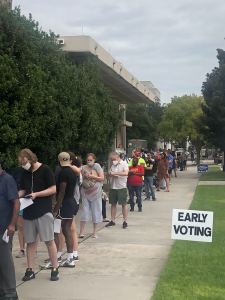
Early voting: History vs. future
The most recent skirmish over the state’s new voting law is a classic case of Georgia’s past colliding head-on with its future. It’s rare that you can put the US Senate, voting lies, Thanksgiving and Robert E. Lee in one story, but here we are.
Short version (really): Georgia legislators passed the recent elections law in direct reaction to false charges of election tampering and moved runoff elections from 9 weeks to 4 weeks from the general election. The move also ran afoul of earlier and amended state laws that protected the day after Thanksgiving as a holiday for state workers. It exists on state calendars as “State Holiday”, but was earlier set aside for remembering Confederate Gen. Robert E. Lee’s birthday (which is really in January). Later amendments to the holiday restrictions omit language about runoffs. On Friday, a Fulton County Superior Court judge ruled that current application law doesn’t include runoffs and early voting to complete the US Senate contest can include the Saturday after Thanksgiving. In answering the complaint filed by Georgia Democrats, he cited the main provision in the law that early voting periods should start as soon as possible. The Georgia Secretary of State Brad Raffensperger, in a statement, said his office plans to appeal. Yesterday, Chatham County announced a Saturday voting location for Nov. 26. The whole drama in the details reminds us that quick legislative moves rarely come without unintended consequences at best and collateral damage at worst.
Why does any of this matter? Let’s look at the data. More than half of all votes for the general election were cast before election day, and voting peaked for women and Black citizens on weekends. As an example, Chatham County opened early voting for 19 days at 5 locations where 49,072 voters cast early votes for the US Senate race. This time they’ll have a maximum of 7 spots — more than most counties — for the US Senate race. To match that turnout, they’ll need an average of 7,000 voters a day. Who votes on weekends? People who must because they hold 9 a.m. to 5 p.m. Monday through Friday jobs whose employers may not allow them time off to vote or they are small business providers who must serve customers on their 9 to 5, weekday schedules.
Early voting is mandatory for 5 days, Nov. 28-Dec. 2. Some Coastal Georgia counties’ elections boards have not yet posted early voting locations or schedules publicly. As we get more information, we’ll post it here.

She said, he said, she sued
Courts have held that free speech includes social media that’s used as a town square. Facebook and Twitter often serve as that space and elected public officials use that to their advantages. Public Service Commission member Tim Echols is a prolific Twitter user, allowing constituents to follow his statewide travels. Last week, one constituent sued the commissioner for blocking her from his Twitter feed for questioning some of his comments and stances.
The plaintiff, Patty Durand, is no ordinary constituent — she challenged Echols for the commission seat before courts took the race off the ballot so the voting districts could be reworked. Echols told The Current’s Mary Landers that he generally blocks people for profanity or explicit language but could not provide an example and a look at 4,500 posts could find none directed at Echols. You can read the story here.

Title pawn: Lucrative industry with few limits
Early last week, The Current published a nearly year-long reporting project that looks at title-pawn lending and how the unregulated industry can drown borrowers into deeper debt, often taking away their transportation to any job that might help pay off the loan. The work, reported by Editor in Chief Margaret Coker through our partnership with ProPublica’s Local Reporting Network, talked to people who were driven to bankruptcy to pay medical bills and to help family members as well as experts who see the toll of the spiraling debt.
While Georgia has made it a felony to offer high-interest payday loans, it does not regulate lending based on car titles that often charge triple-digit annual interest rates. The state is now home to three of the nation’s largest title lenders, including Savannah-based TitleMax. To figure out how pervasive the industry is in Georgia, Coker and data experts at ProPublica had to find a way to track title pawns in Georgia. They requested 3 years of data from the Department of Revenue to find out how many vehicles had liens from a title lender, cross-referenced them with locations that were verified by calling hundreds of stores in nearly all 159 counties. They found that Georgia title lenders placed liens on an average of 75,000 vehicles annually, some of which can end up with interest rates of as much as 187.5% annually You can read it here.

Doing the work
Journalism like Margaret Coker’s title-lending project takes time and focus to find experts, quantify, learn and explain how title pawns work along with the direct effects the debt has on Coastal Georgians who are already have few resources left. It is also a great example of the new collaborative model of journalism we practice at The Current. Our work is free for others to use so we can reach everyone with deeply reported, credible information. So far, this work has been republished by more than 10 sites and publications that together literally serve millions across the state; it also was republished nationally through ProPublica. In addition to ProPublica’s support, students in the Covering Poverty Project at the University of Georgia’s Cox Institute for Journalism Innovation, Management and Leadership contributed research. Reporting for this project was supported by a grant from the Fund for Investigative Journalism. We can’t do it without their help — or yours.

Considerable
- Immigrant abuses: Last week members of a US Senate investigative panel led by Georgia US Sen. Jon Ossoff heard testimony from victims, doctors, nurses and government officials about the brazen abuses of female detainees in a Georgia detention center. The bipartisan investigation, sparked by a nurse, found that women were subjected to unnecessary gynecological surgeries including hysterectomies without their consent.
- Georgia moves forward on Medicaid work requirement: Gov. Brian Kemp’s on-off-on plan to extend Medicaid to 50,000 uninsured Georgians is moving closer to reality. A full Medicare expansion would cover 450,000. The plan would require a minimum of 80 hours of work or volunteering per month. Georgia will be the only state in the country with the requirement and others are watching.

Your second cup: Does Twitter matter?
If you’re one of those people who wonders why everyone seems to work off their own set of accepted facts, you can point to the savage dilution of “the media” for that. The “media” is anything out there that you can watch, read or listen to — and that includes a lot of information that’s not gathered in a rigorous fact-checked way. The social media platform Twitter has been able to become a personal news feed for all, allowing for video, stories, and perspectives combined with facts and misinformation from all corners. It’s considered much like a town square where almost everyone (including the ill-informed) openly speak his or her own piece. Listeners could judge for themselves as they knew the source of the information. If the social media platform’s new owner, Elon Musk, has indeed allowed the credibility, technical capacities and safety and security capabilities of the platform to erode, then Twitter’s days are numbered. The platform has proven (again) that a common, credible ways to reach others and to filter and fact-check as stories evolve is valuable. The open and common areas help punch holes in the hard-walled silos of messages designed only to validate beliefs instead of challenging the recipients to consider other possibilities. An information researcher tells us that we’ll lose an archive of humanity and raw data, as well as a constant news source that often checks itself well as stories evolve.
Enjoy.
Court allows Saturday early voting for Georgia’s U.S. Senate runoff
A Fulton County Superior Court judge ruled Friday that holding early voting on the Saturday after Thanksgiving Day is legal and may proceed.

Chatham County open Saturday, Sunday for early voting for runoff
Chatham County has added a Sunday to the early voting days before the Dec. 6 runoff for Georgia’s US Senate seat. The state only mandates 5 weekdays before the election.

An elected Georgia energy regulator blocked her; now she’s suing
A complaint filed Tuesday in federal district court idetails how PDC member Tim Echols blocked candidate for his post from his Twitter, Facebook feeds after she tweeted criticism of Echols’ failed attempt to pass any of about a dozen changes to Georgia Power’s long-term plan.

How title lenders trap poor Georgians in debt with triple-digit interest rates
Georgia law protects working poor from some predatory loans. But title lenders like TitleMax get away with charging triple-digit interest rates. Here’s how.

Migrant women endured medical mistreatment at Georgia ICE facility, U.S. Senate report finds
Bipartisan report found migrant women who were detained at Irwin County Detention Center, known as ICDC, in Georgia were subjected to “excessive, invasive, and often unnecessary gynecological procedures,” and many of the women did not consent or understand the procedures they underwent.

Path cleared for Georgia to launch work requirements for Medicaid
Republican Gov. Brian Kemp’s reelection — and a surprising Biden administration decision not to appeal a federal court ruling — have freed the state to introduce its plan that would allow for a limited increase in the pool of low-income residents eligible for Medicaid.

If Twitter dies, what do we lose? Eyewitness accounts, raw data on human behavior, and trolls
The Twitter archives allow for instant and complete access to every public tweet, which has positioned Twitter both as a archive of collective human behavior and as a credentialing and fact-checking service on a global scale.
Support non-partisan, solutions-based investigative journalism without bias, fear or favor on issues affecting Savannah and Coastal Georgia.


You must be logged in to post a comment.